
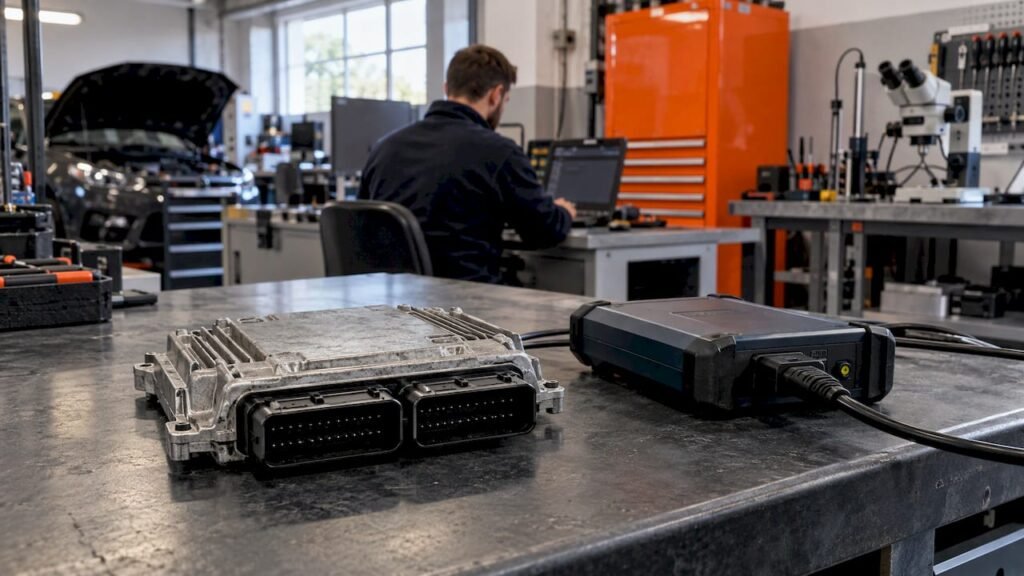
An engine control module file is the software image stored in an ECM: the program and calibration data that decide how the module runs the engine. For repair, restoration and replacement work, the file you need is the original, unmodified one, and the only reliable way to pick it is to match the hardware number, software number and calibration ID against what your own read of the module reports. Our catalog of original ECU files in .bin format is built around exactly that search, at a fixed €19.99 per file.
TL;DR
- An ECM file is the module’s software and calibration data. PCM, ECM and TCM are all computerized controllers that carry their own software, and each has its own file.
- Match HW number, SW number and calibration ID against your own ECU read before you buy or write anything.
- A full read and a flash-only read are different things. Size, memory layout and checksum needs vary by ECU family, software version and tool.
- Our files are original, unmodified .bin files, not tuning maps. DAMOS and A2L files are not included.
- Every file costs €19.99. The download link is emailed automatically once Stripe confirms payment.
Table of Contents
- What an engine control module file actually is
- Stock files versus modified files
- Identifiers that pick the right file
- Full read or flash-only read
- File size, layout and checksums
- Why mismatches are costly
- Trucks, commercial vehicles and agricultural machinery
- Finding your file with us
- FAQ
- Sources
What an engine control module file actually is
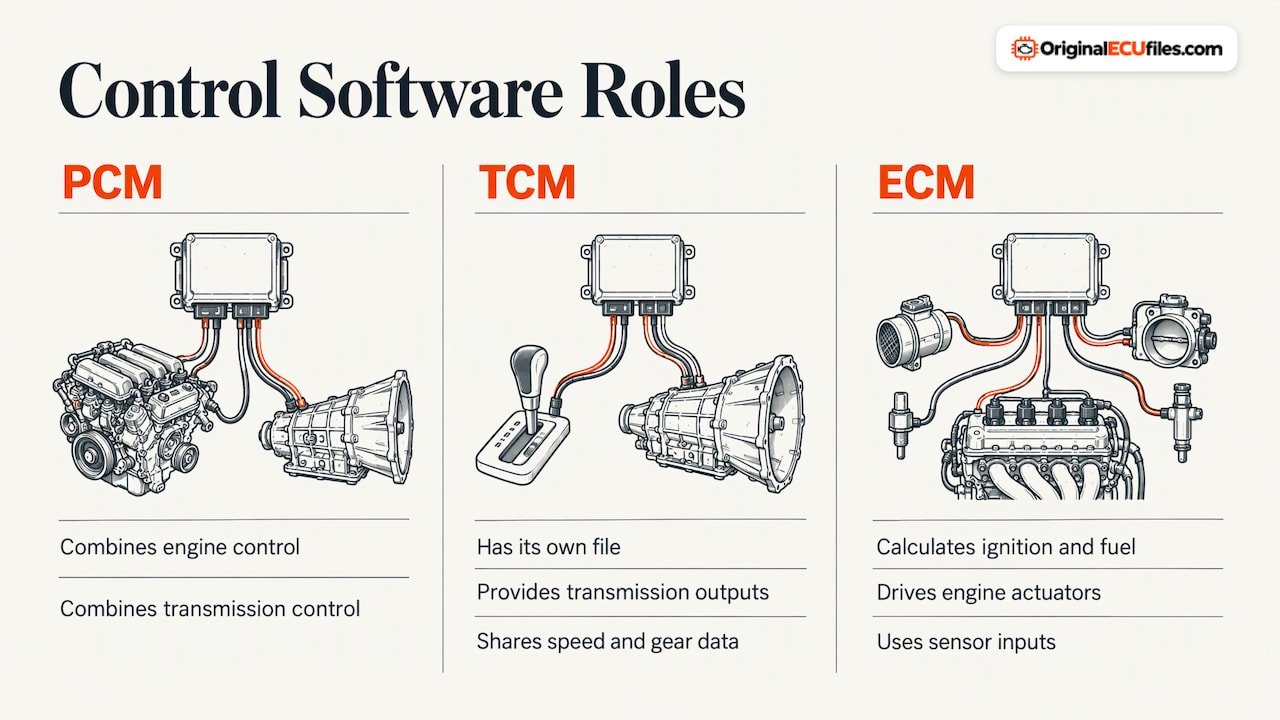
Toyota uses “ECU” as a generic term for any computerized device that manages a system or subsystem, and its service bulletin lists the PCM, ECM and TCM under it (Toyota Techstream flash bulletin, 2016). That matches how the terms appear in the shop. “Powertrain control software” usually means the PCM, which combines engine and transmission control. “Transmission control software” is the TCM’s own file. “Engine control module files” are the ECM’s.
The ECM calculates ignition and fuel requirements, drives the engine actuators and takes input from sensors and other modules. The TCM provides transmission outputs and passes data such as vehicle speed and gear selection to other modules, according to the ASE L1 study guide. Bosch’s M-Motronic documentation describes the same logic: the unit combines inputs such as engine temperature, air quantity, throttle angle, oxygen and knock signals, then commands the actuators (Bosch M-Motronic technical instruction).
The practical consequence is that the engine file does not live alone. A 2008 Smart service manual describes an engine control unit talking over CAN with the automated transmission controller and other modules (Smart fortwo introduction to service). When you restore or replace one module, the file has to suit the vehicle it will talk to, not only the chip it is written to.
Stock files versus modified files
An original (stock, ORI) file is the software as the manufacturer or supplier released it. A modified file has had calibration data changed. They are not interchangeable in restoration work: if the aim is to return a module to a known baseline, only the original serves.
The difference also matters on vehicles that go through dealer updates. A Volkswagen bulletin warns that an update can overwrite tuned ECM or TCM software and calls for owner notification and written consent before flashing a tuned module (Volkswagen technical bulletin, updated 2023). Knowing whether a module holds stock or modified software before you touch it saves an argument later.
We supply stock files only. We are not a tuning service, a programming service or a diagnostic support provider, and we do not sell modified maps.

Identifiers that pick the right file
Three identifiers do most of the work.
| Identifier | What it tells you | Where it comes from |
|---|---|---|
| Hardware number (HW) | The physical ECU variant | Label on the unit and your tool’s identification screen |
| Software number (SW) | The software release inside it | Your tool’s read of the module |
| Calibration ID | The calibration set within that software | Identification data in the read |
On current vehicles, a scan tool can report the software part number and revision directly. APR’s guide gives a VW-group example, part number 8Y0 906 264 A with revision 0001 (APR box code guide). The UDS diagnostic standard defines standard data identifiers for this, including the VIN at 0xF190, the manufacturer ECU software number at 0xF188 and the supplier software version at 0xF195, as documented in an open-source firmware fingerprinting reference. Which identifiers a given ECU actually exposes depends on the ECU and the tool.
The rule we apply: compare every available identifier with your own read. Do not rely on the vehicle’s model and year alone, because one model year can carry several ECU hardware and software combinations. Toyota’s own flash process works the same way, checking vehicle applicability and calibration ID first, and its notes say flash calibration updates are specific to vehicle and ECU combinations (Toyota bulletin).
Searching by hardware number
If you have the Bosch part number from the label, search by it. Examples from our catalog: 0281001611, a Bosch EDC SG, 0281001613, also EDC SG with two files, and 0281001761, a Bosch MS6.1. A hardware number can list more than one file, which is why SW and calibration ID decide the final pick. You can also browse original ECU files by ECU type across Bosch, Delphi and Denso.
Full read or flash-only read
This is the distinction that causes most failed restorations.
- Flash-only read: the program flash area. It holds the software and calibration, and it is what a reflash normally works with.
- Full read: the flash plus other memory areas, which may include EEPROM or microcontroller data, depending on the ECU. Vehicle-specific data, such as immobilizer or security information, can sit in these other areas.
A company guide on virtual versus physical reads makes the same point: a virtual calibration file may not contain the vehicle-specific data needed for cloning, and cloning requirements depend on the memory areas and a compatible donor hardware (ECUHELP guide, 2026).
So, before you buy, decide what your job needs. Restoring corrupted calibration on a module whose other data is intact is a different job from replacing a dead unit. Our files are original software references in .bin format. Whether one covers everything your procedure requires depends on the ECU family and your tool, and we do not claim a universal procedure.
File size, layout and checksums
These vary by ECU family, software version and tool, so check your own read before comparing:
- File size should match what your tool reads from the same ECU family. A different size usually means a different memory scope, for example flash-only against full read.
- Memory layout differs between families. Some tools present the data in a different order or split it into regions.
- Checksums are required by some ECUs and tools. Whether a write needs checksum correction depends on the family and the tool you use.
- Security and signing may apply. OEM update packages can carry memory layout, part numbers and signing data, and packaging varies by manufacturer, sometimes with compression or encryption (I CAN Hack knowledge base). Toyota’s 2023 bulletin says a security signature is required before flash starts on the covered vehicles (Toyota GTS+ bulletin).
OEM update formats are not the same as .bin reads. Toyota CUW files and VAG FRF files, for example, hold manufacturer programming data distributed through the OEM’s own systems, as the same I CAN Hack guide describes. A stock .bin from a read is a different object, and your tool decides how it is written back.
Why mismatches are costly
Toyota’s bulletin says ECU security prevents programming with another ECU’s information and that flash errors can permanently damage the ECU (Toyota bulletin). The same procedure requires stable power; it specifies a power-supply mode that holds 13.5 volts during reprogramming. Your vehicle and tool will have their own requirements, so follow the tool maker’s procedure.
A sensible pre-write routine, whatever the brand:
- Record HW, SW and calibration ID from the ECU you are working on.
- Save your own full read before changing anything.
- Match every identifier to the file’s listing.
- Confirm the file scope fits your read: flash-only or full.
- Hold stable supply voltage during the write.
Trucks, commercial vehicles and agricultural machinery
Commercial engine control files follow the same logic with higher stakes, since downtime is expensive. Searches such as truck engine control files or commercial vehicle ECU compatibility come down to the same identifiers: ECU manufacturer, ECU type, HW, SW and calibration ID. Our catalog covers passenger cars, commercial vehicles, motorcycles and agricultural machinery across more than 500 brands, and we do not claim compatibility beyond what the listing’s identifiers show.
For trucks you can start from the brand pages, such as MAN or Detroit Diesel. For passenger and light vehicles, brand pages such as Toyota, GM and GMC work the same way, narrowing by model, engine variant and ECU type.
Finding your file with us
Our catalog holds over 196,000 original ECU files. You can search by vehicle brand, model, engine variant, ECU manufacturer, ECU type, HW number, SW number and calibration ID. Each file is sold individually at €19.99 through Stripe checkout, and the download link is emailed automatically after Stripe confirms payment. Start at our original ECU files catalog.
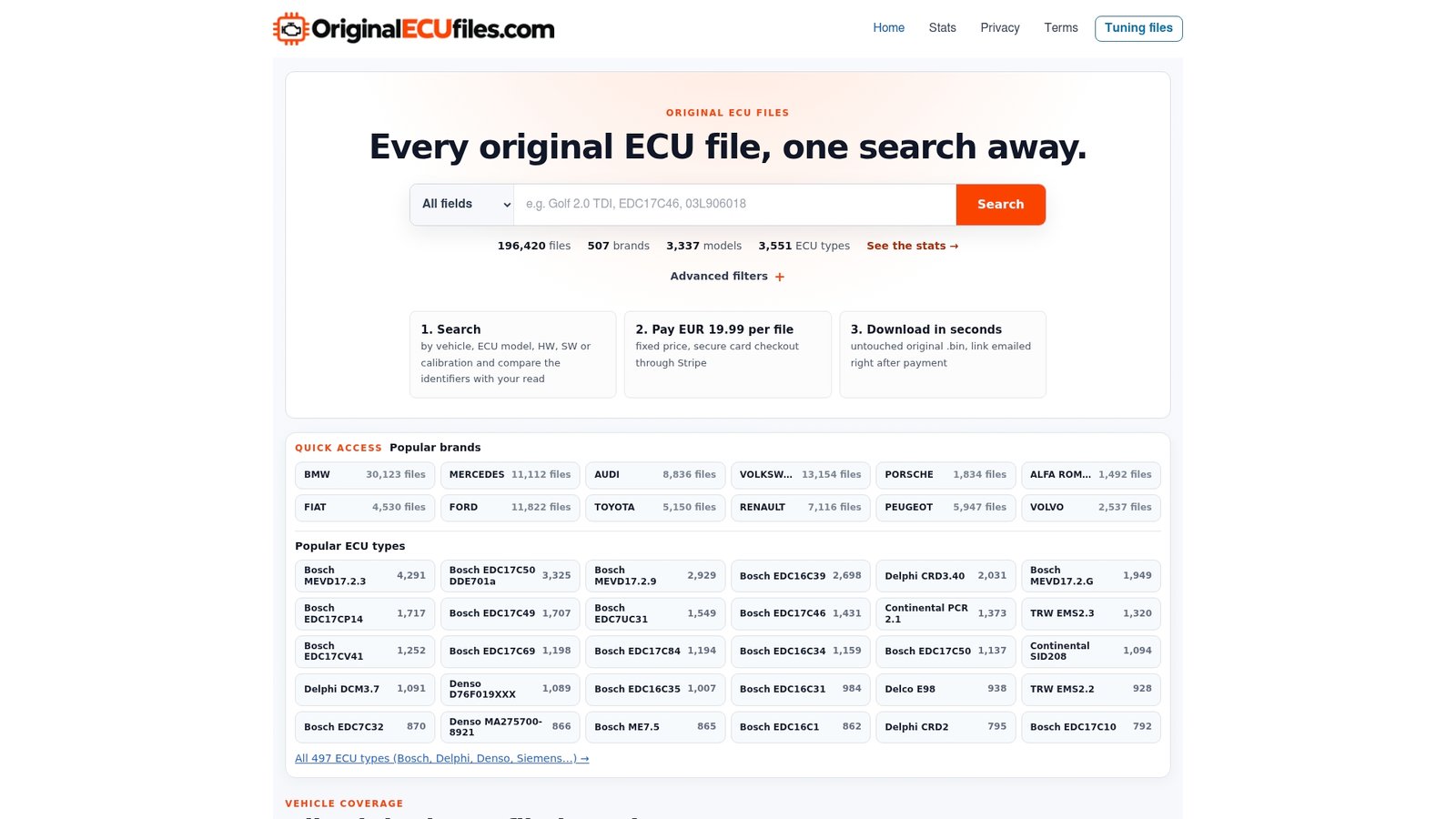
Verify the hardware, software and calibration identifiers against your own read before you purchase.
FAQ
Are engine control module files the same as tuning files?
No. Engine control module files here are original, unmodified software in .bin format. Tuning files carry changed calibration data. We sell only the original files.
Is an ECM file the same as a PCM or TCM file?
They are different controllers with their own software. PCM, ECM and TCM all fall under the general term ECU in OEM documentation. Match the file to the module you actually read.
Do the files include DAMOS or A2L files?
No. DAMOS and A2L files are not included with original file downloads. You receive the original ECU software file.
How fast do I get the file after paying?
The download link is emailed automatically after Stripe confirms payment. Check your email address at checkout so the link reaches you.
Sources
- Toyota Techstream ECU Flash Reprogramming Procedure, 2016
- Toyota GTS+ ECU Flash Reprogramming With Security, 2023
- Volkswagen technical bulletin, updated 2023
- ASE Advanced Engine Performance Specialist (L1) study guide
- Bosch M-Motronic Engine Management technical instruction
- Smart fortwo (451) introduction to service manual
- APR box code information
- Firmware fingerprinting reference
- OEM Update Files, I CAN Hack knowledge base
- Virtual Read vs Physical Read ECU Guide, 2026