
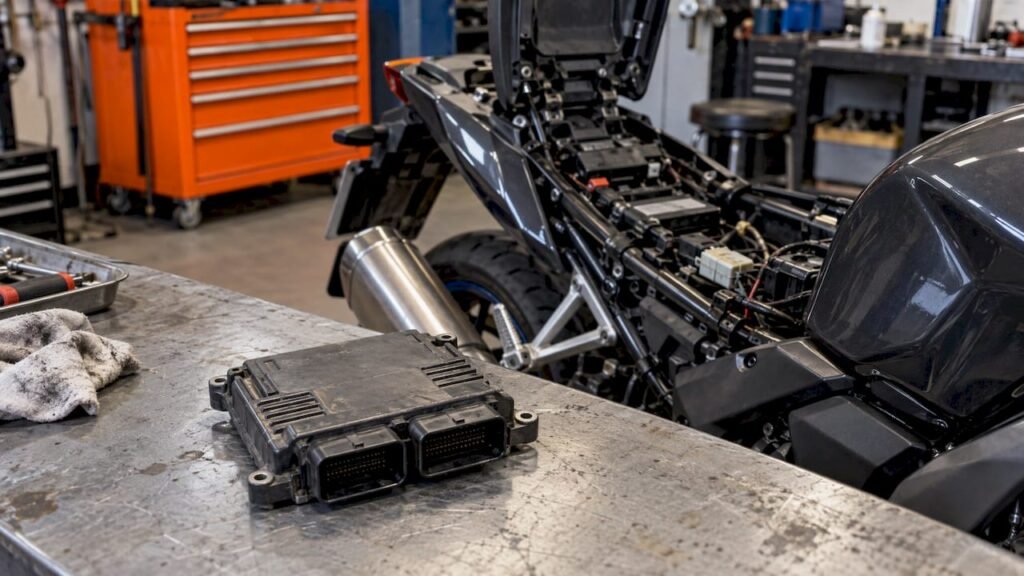
A motorcycle ECU replacement goes right when the new unit carries the exact original software for that bike, and goes wrong when a file is chosen by model name alone. Match the ECU part number, hardware number and software number first, then load the stock file that belongs to those identifiers. We supply original, unmodified ECU files for professionals at a fixed €19.99 per file, searchable by exactly those identifiers on Original ECU Files.
TL;DR
-
The ECU calculates fuel injection and ignition timing from sensor data, so a replacement unit has to run the software written for that exact bike.
-
Identify the bike by make, model, year and engine, then the ECU by part number, hardware number or revision and software identification. Never identify it by housing alone.
-
Swapping the unit is basic work. Flashing it and setting its values is specialist work.
-
Depending on the model, you may also need coding, adaptation, immobilizer or key registration after the swap.
-
Verify with a full diagnostic check and a test, because a successful write does not prove the bike is road-ready.
Table of Contents
What the ECU does and why it matters for a swap
The engine control unit (ECU, sometimes called ECM) is the computer that decides how much fuel the injectors deliver and when the spark fires. Honda’s aftersales material describes the principle: the unit reads engine and intake-air temperature, engine speed, throttle opening and intake-air pressure, and combines them with preset fuel maps to calculate injection volume and ignition timing.
That has a direct consequence for replacement. The hardware is only half of the unit. The other half is the software and calibration that tell it how this particular engine, exhaust, airbox and sensor set should behave. A replacement that carries the wrong software may power up and still run poorly, or not run at all.
The ECU also keeps watch over itself and the sensors. When signals look abnormal, it can light the engine warning lamp, store a fault and fall back on safe values. Manufacturer service information separates a sensor fault from an internal memory fault in the unit itself, and the latter can prevent starting. That distinction is the first diagnostic fork for a technician: a bad sensor or wiring problem does not call for a new ECU, a failed internal memory does.

When a motorcycle ECU actually needs replacing
Typical reasons a workshop ends up with a replacement job:
-
Internal failure. The bike does not start or communicate, and sensor, harness and power checks come back clean.
-
Electrical damage. Water ingress, a shorted harness, a reversed battery connection or a fire can destroy the unit. Owners on riding forums describe exactly this after electrical fires, where the electronics had to be replaced.
-
A corrupted or lost software image. The hardware is fine, but the stored program is damaged, for example after an interrupted write.
-
Recall or manufacturer campaign. Replacement is not always a breakdown. In 2018 Suzuki reported a UK recall of just over 600 GSX-R1000 and GSX-R1000R motorcycles in which the ECU was replaced to address a gear-selection risk at high revs.
-
Previous modification. A bike arrives with a changed map or an unknown file, and the shop needs to bring it back to stock.
In the last two cases, the original file is the whole point. You are restoring factory behavior, so you want the unmodified software for that unit.
Can you replace a motorcycle ECU yourself?
Partly. Unbolting a unit and reinstalling it takes basic skills. Flashing it and selecting mapping values and settings, however, is described by American Sport Touring as intricate work best left to experts. In practice the job splits into three layers:
-
Physical swap: access, connectors, mounting, harness routing.
-
Software layer: reading, writing and verifying the file in the unit.
-
Vehicle layer: coding, adaptation and any security or key registration the model requires.
Owners who stop at layer one often end up with a bike that cranks but will not run, or runs with the wrong fueling. Professional technicians handle all three layers, and the second one is where the correct original file comes in.
Step by step: replacing a motorcycle ECU
1. Confirm the ECU is the problem
Read the fault codes, check the supply voltage, grounds, fuses and main relay, and inspect the connector for corrosion or bent pins. Confirm the sensors the ECU relies on are plausible. Replacing a unit because of a failed sensor or a chafed wire wastes money and can damage the new unit if the underlying short remains.
2. Record the bike’s identity
Write down manufacturer, model, production year, VIN and engine configuration. Market variants matter: a US-specification bike and a European one of the same model can carry different ECUs and calibrations because of emissions equipment and regional settings.
3. Read the ECU label and any stored identifiers
Note the ECU manufacturer, the part number, the hardware number or revision and the software identification. Technical guidance from programming-tool makers is blunt on this point: a controller should never be identified solely by its external appearance, because housings can be identical while processors and programming protocols differ. A file from another motorcycle is not automatically compatible, even when displacement and model name appear identical, per the same publisher’s compatibility guide.
This is the step where searching by identifier saves time. In our database you can search by brand, model, engine variant, ECU manufacturer, ECU type, hardware number, software number and calibration ID, so the file you find is tied to the unit in your hands, not to a model name.
3b. Preserve what is on the old unit
If the old ECU still communicates and your tool supports a read, save its data before touching anything. Preserving original data is strongly recommended when the protocol supports it. If the old unit is dead, the stock file for its identifiers is your reference.
4. Prepare the bench and the bike
Before applying power to a unit on the bench, verify the wiring diagram, supply voltage and polarity, and make sure ground connections are secure. Use a stable power supply during any write. A voltage drop mid-write is a classic way to corrupt a unit.
5. Load the correct original file
Verify the part number, hardware number and revision, software identification, processor family where relevant, target memory region, file format and size, and the file’s source before writing. The source matters most for a restore. A stock file from a catalog built only on unmodified software gives the technician a known reference point; a file of unknown origin could be a modified map from another bike.
Our catalog holds over 196,000 original ECU files across more than 500 vehicle brands, including motorcycles. Each file is individually purchasable at €19.99, with secure Stripe checkout, and the download is delivered by email within seconds of payment, so the unit is not left waiting on the bench. Always verify the hardware, software and calibration identifiers against the unit before you buy.
6. Complete coding, adaptation and security steps
Depending on the model, replacement may require coding, adaptation, initialization or manufacturer-specific security authorization. Cloning or writing a file does not automatically complete every security or configuration requirement, according to programming guidance for motorcycle ECUs. More on this below.
7. Verify before the bike leaves
A successful write is not proof of a functional, road-ready motorcycle. Run a full diagnostic scan, clear and recheck codes, confirm live sensor data is plausible, check idle, throttle response and warm-up behavior, and road-test. Then recheck for stored faults.
Immobilizers, keys and clones
Many modern bikes tie the ECU to the keys. If the unit is replaced, it may need to be registered to the immobilizer before the engine will run. Manufacturer systems differ. One example is Kawasaki’s KIPASS system, where a replacement ECU needs to be registered with the FI ECU, steering lock ECU, tire pressure sensors and immobilizer key fobs using the dealer diagnostic tool.
Cloning is a different route: copying the old ECU’s data to a new blank one. It depends on the old unit still communicating, and support varies unit by unit. Public duplication lists show some ECUs can be cloned one to one while others, such as a Harley-Davidson MT22, are listed as no-clone. When the original is dead, cloning is off the table and the stock file is the way back.
Why the original file matters
It is tempting to treat the file as a commodity. It is not. The software contains the fuel and ignition maps the engine was validated with. Loading the wrong maps could permanently brick a unit, and a badly set-up ECU could damage the engine, as Bennetts’ guide to ECU reflashing notes. Restoring stock means the engine returns to the behavior the manufacturer designed, which is also the right baseline if the bike will later be tuned.
Our service supplies only stock ECU software files, not modified tuning maps. That focus is deliberate: it serves repair, software restoration, ECU replacement and diagnostics, where an unmodified reference is what the job calls for.
Finding the right file by brand
Motorcycle coverage is organized by brand, so you can narrow quickly. Examples of brand pages in the catalog:
From a brand page, narrow by model and engine variant, then match the ECU type and the hardware, software and calibration numbers. The identifiers decide the file, the model name only gets you to the right shelf.
A worked example of the identification logic
Imagine two bikes of the same model and year arriving in a shop with dead ECUs. One was built for the US market, the other for Europe. The housings look identical. The labels, however, show different part numbers, and one carries a newer hardware revision. If the technician picks a file by model name, one of the two units gets a file that was written for a different calibration. The bike might start, but with fueling that does not fit its emissions hardware, or it might not start at all.
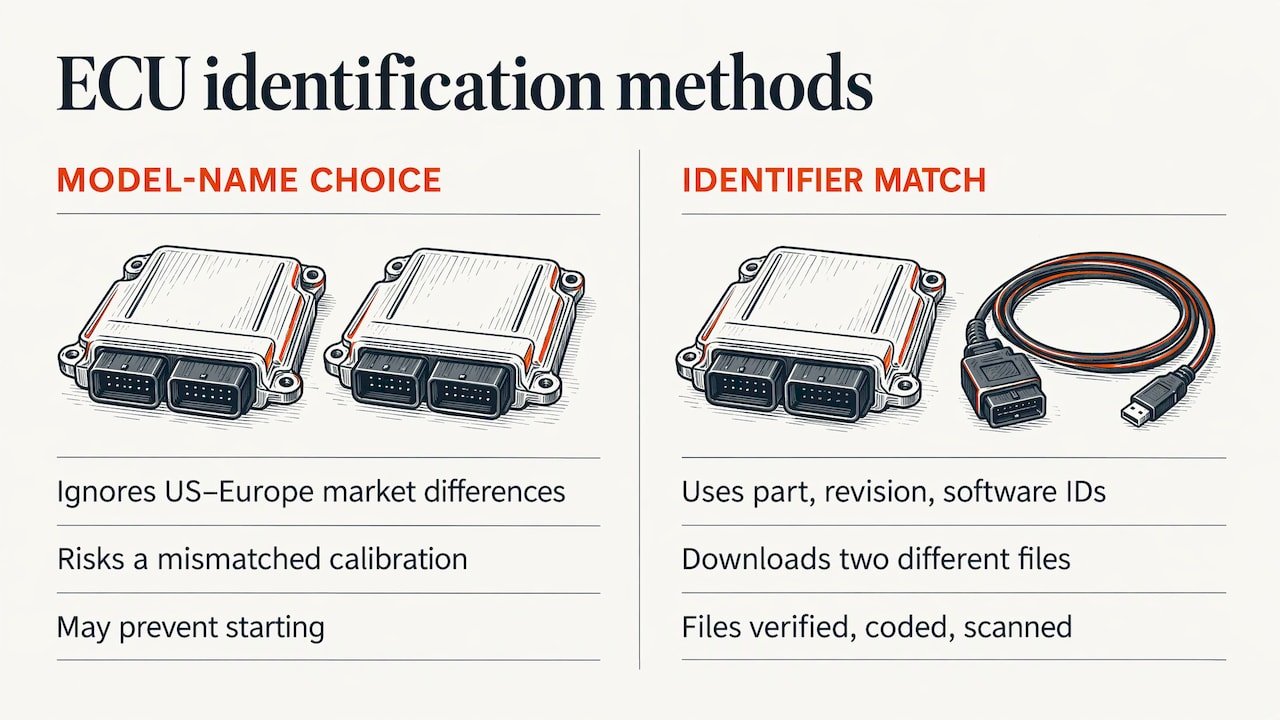
Run the same job by identifiers and the outcome changes. The technician reads the part number, hardware revision and software ID from each label, searches for each combination and downloads two different files. Each unit is written with the file that matches, verified, coded and scanned. The model name never enters the decision.
Common mistakes in motorcycle ECU swaps
-
Buying by model name. Same displacement, same name, different ECU. Identify by number.
-
Skipping the read. If the old unit talks, save its data first.
-
Weak power on the bench. Low or unstable voltage during a write is a leading cause of failed flashes.
-
Forgetting the security layer. A running ECU that is not paired with the keys can still leave the bike immobilized.
-
Skipping the final scan. A clean write is not the same as a working motorcycle.
-
Reusing a modified file. A file of unknown origin can carry changes you did not intend. Restoration calls for stock.
Our offer for workshops
If you handle ECU repair, replacement or restoration for riders, the file is one input you should not have to guess. Our catalog lets you search by the identifiers on the unit itself, at a fixed €19.99 per file, with automatic email delivery after secure checkout. Start from the Original ECU Files search and match the part, hardware, software and calibration numbers before you order.
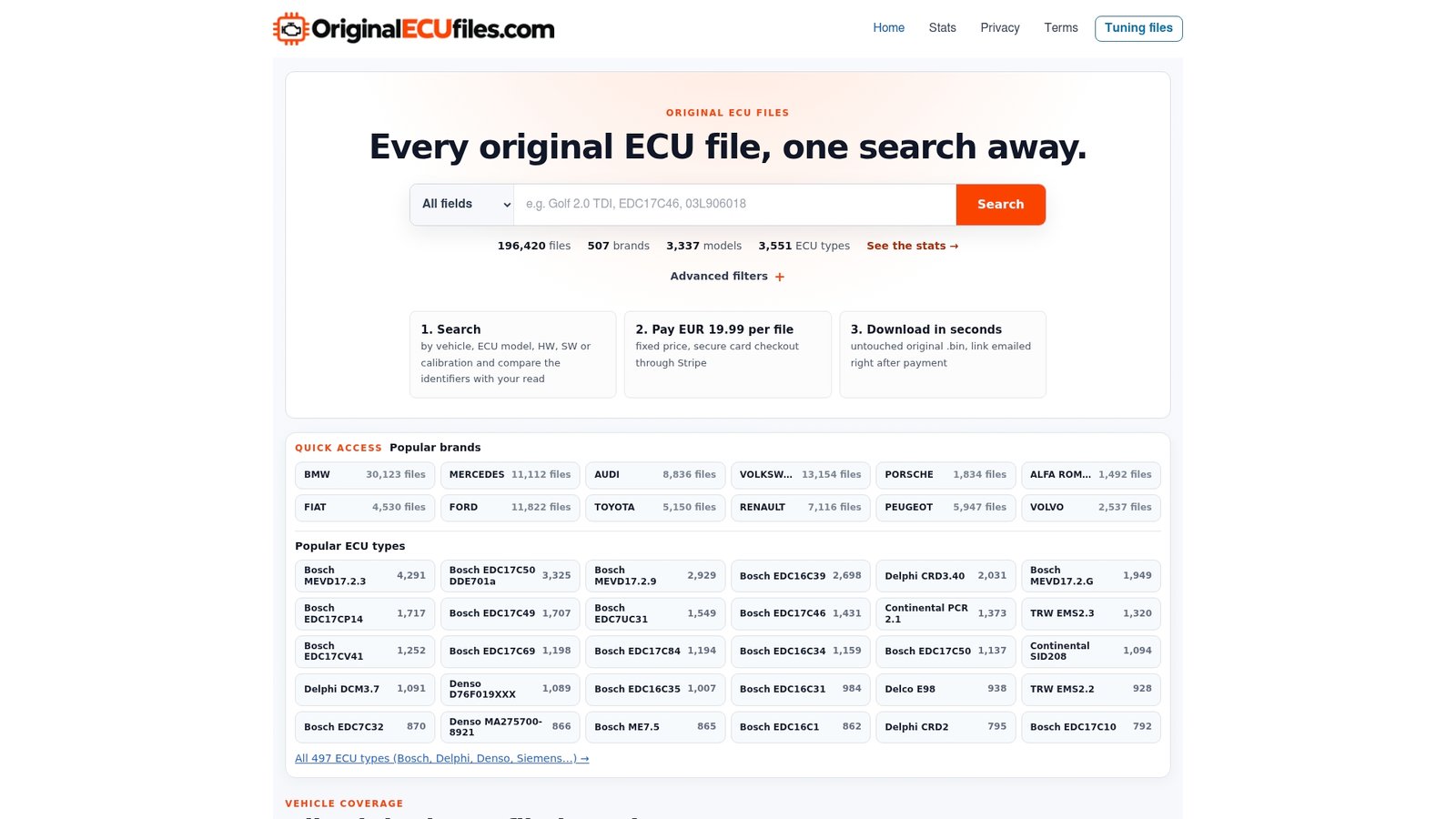
The service is built for professionals: repair shops, remapping workshops, diagnostic specialists and independent technicians working with ECU firmware. It is not a source of modified tuning maps.
FAQ
Can you replace a motorcycle ECU yourself?
The physical swap needs only basic skills. Flashing the unit and choosing its settings are intricate tasks that experts handle best. For a bike that must run correctly and pass a diagnostic check, the software and coding layers are where a professional workshop earns its keep.
What is the ECU in a bike?
It is the computer that uses sensor inputs such as temperature, engine speed, throttle opening and intake pressure to calculate how much fuel to inject and when to fire the spark, as Honda describes. It also stores fault information and can trigger the engine warning light.
Do I need the original software file for a replacement ECU?
Yes, the replacement has to run the software that matches its hardware and the bike. Match the ECU part number, hardware number or revision and software identification, not just the model name. A stock file for those identifiers restores factory behavior.
Does a replacement ECU need to be programmed to the bike?
Often. Depending on the model, it may need coding, adaptation, initialization or security authorization, and writing a file does not complete all of these. Systems with immobilizers also require the unit and keys to be registered together.